It is getting closer to Christmas and I am getting in the mood to start making ornaments. Been looking at various pieces of jewelry on Pinterest. As stated before, many of my ornament ideas come from pendants, earrings and other pieces of jewelry, especially if I am designing ornaments for a miniature tree. Sometimes, the piece can be enlarged to “normal” ornament size just by increasing the size of the beads, other times not and the enlarged ornament will need to be re-worked to include the additional use of beads. With an increase in the number of beads, also comes the increase in weight from the additional supplies.
Thinking about doing more of the wooden spool ornaments from last year, already have eight designs for people who are fans of the University of Alabama, and my godson will be ‘graduated’ from Mickey to the Teenage Mutant Ninja Turtles which have been designed to make four different ornaments.
Over the years several people have received miniature trees from me and I have about four (4) 2-foot trees in storage that I thought about making with the possibility of selling. Usually each tree has 80 to 130 mini lights on them mixing both battery-powered as well as outlet, usually will use white lights. I will put about 100 miniature hand-made ornaments, 25 different styles with four ornaments placed around the tree. Most of the ornaments will be between 0.5 inch and 2 inches in height so that the ornaments are in scale with the tree. The first tree I made 10 years ago, had over 40 pairs of earrings mixed in with the miniature ornaments. Since then, I have been on the look-out for earring designs which I can make as miniature ornaments.
Have many old designs of miniatures from past years which I already have extra ornaments hanging up and have ‘discovered’ several more that can easily be turned into miniature ornaments. So the new trees would have enough variation of ornaments so each tree won’t look a-like. I try to make four of each design so that one can be placed on each quarter of the tree with two of them placed on the top half and two on the bottom half.
The only thing on the tree I usually don’t make is the tree topper, I will purchase a pre-made miniature topper but will add elements to it.
Showing posts with label earrings. Show all posts
Showing posts with label earrings. Show all posts
Tuesday, March 17, 2015

Tuesday, June 25, 2013
Earrings or Ornaments?
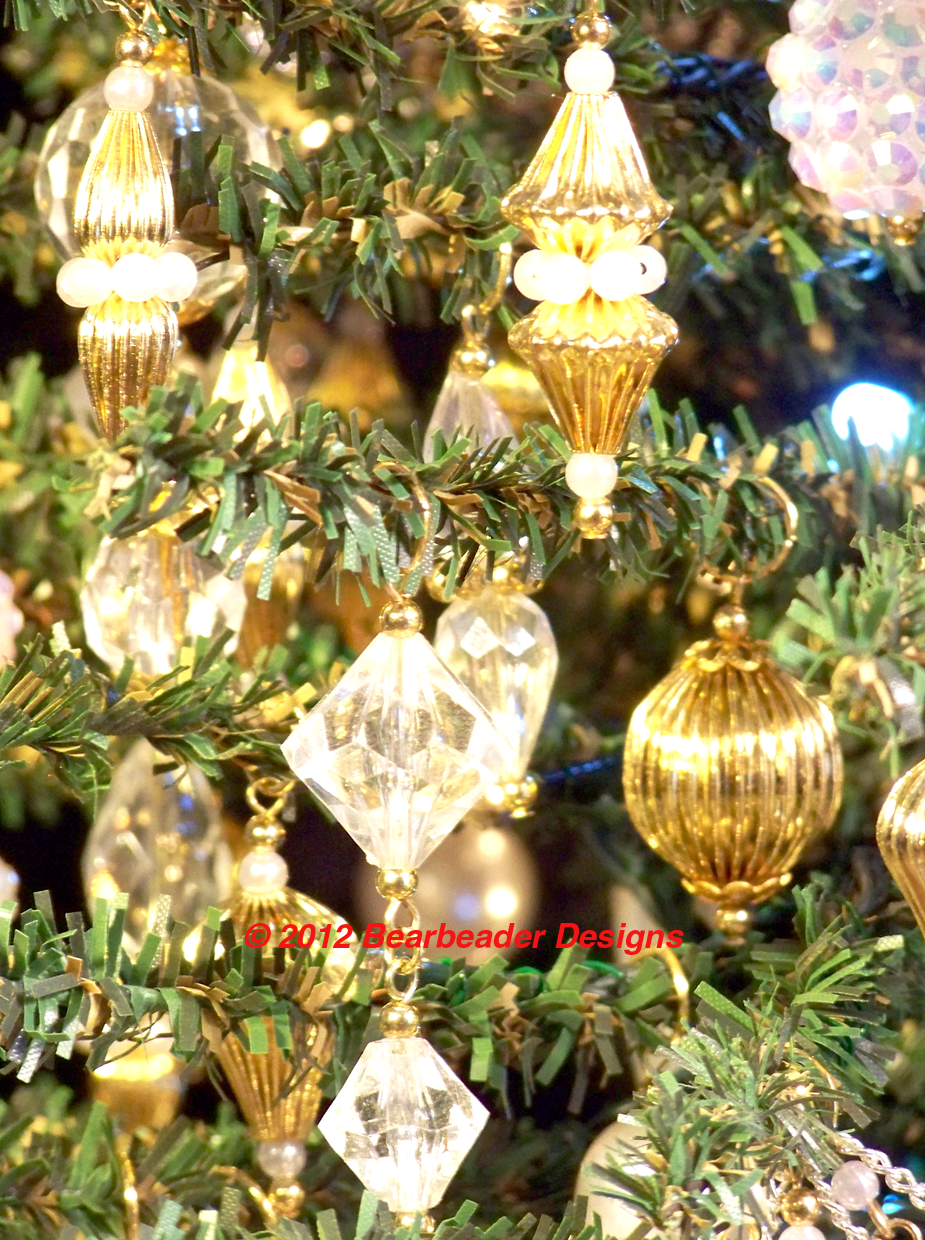
When looking for ornaments to go on a tree, I had created ornaments which have been inspired by jewelry. There are times when I have purchased pieces of jewelry to use as ornaments. A crystal necklace can be used as a swag between branches, or ‘floating’ pearl necklaces linked together with chain can create a garland. More than once I have used large shiny, dangly earrings as ornaments. The miniature tree can easily be decorated with earrings, especially these with french-hooks instead of posts or clip-ons.
When I belonged to a group where miniature ornaments would be exchanged, many months I fell back on my years of making costume jewelry and made ornaments which could easily be worn as earrings if you had a pair and a couple of french-hook style ear wires.


Some are made from an earring base such as these larger ornaments. Using Delicas® as spacer beads, I was able to fill the space between the chain lengths and the faceted glass beads. With the wide variety of glass colors, the combinations were almost endless.
The drawback to these being earrings are the weight. These ornaments were easily 2 to 3 ounces, which most people think is very little weight until they are hung from a single thin wire and have a tendency to swing when you walk and smack your head when you turn your too quickly.
Others are made from a mixture of bead caps and earring findings. This group of 5 are all under 2.5" in height. And are limited only to the colors of the accent beads or the finish of the findings themselves.


When I belonged to a group where miniature ornaments would be exchanged, many months I fell back on my years of making costume jewelry and made ornaments which could easily be worn as earrings if you had a pair and a couple of french-hook style ear wires.


Some are made from an earring base such as these larger ornaments. Using Delicas® as spacer beads, I was able to fill the space between the chain lengths and the faceted glass beads. With the wide variety of glass colors, the combinations were almost endless.
The drawback to these being earrings are the weight. These ornaments were easily 2 to 3 ounces, which most people think is very little weight until they are hung from a single thin wire and have a tendency to swing when you walk and smack your head when you turn your too quickly.
Others are made from a mixture of bead caps and earring findings. This group of 5 are all under 2.5" in height. And are limited only to the colors of the accent beads or the finish of the findings themselves.


Thursday, May 30, 2013
"Everyone Deserves a Christmas Tree" or "My Trip Down the Minature Rabbit Hole"
After Thanksgiving several years ago, I was eating at one of my favorite local restaurants in Greensboro, NC, I asked the waiter if he had his tree up yet. He told me that he did not, and that most likely he wouldn’t due to space and the time putting up and then having to take down the tree. As I drove home, I was bothered and I kept on thinking ‘Everyone deserves a Christmas tree.’
Over the next few days I decided I would make a miniature tree for him, fully lit and decorated so all he had to do was plug the tree in. I found a 24 inch tree at one of the local craft stores. The tree have ‘needles’ about 0.50" long and about 50 branches. I found several packs of battery powered ‘rice’ lights, along with a 35 bulb strand of LED lights, and I started to work.
I took the wrapping from around the bottom and secured the tree base to a 12x12x0.625" piece of plastic cutting board. Fluffing the tree branches out to give an appearance of a ‘natural’ tree, I started securing the lights to the branches with small pieces of 26 gauge floral wire. Just like larger trees, it is best to have the lights on when doing this. The LED lights were a ‘cool white’ with a bluish tint and very bright, so I positioned them along the trunk of the tree. With the long ‘needles’ and fluffed branches a gentle cool glow would be emitted from the center of the tree. Next I positioned the battery-powered ‘rice’ lights. Dividing the tree into quarters, I strung the lights along the branches, wiring them into place, one bulb per branch near the tip. Each pack of ‘rice’ lights had 20 bulbs so I had a few left over when I reached the longer, lower branches. The ‘rice’ lights gave off a ‘warm white’ light.


After the tree was lit, I started the ornaments. I had decided when I started I would want the ornaments to be ‘in scale’ with the tree, so for a 2-foot tree the scale would be 1:4 if most trees are around 8-foot. Most globes on trees are between 65mm to 80mm (2.5" to 3.25"), so the globe ornaments would need to be between 15mm to 20mm and any ‘fancy’ ornaments no larger than 2" in length. Many of the ornaments were simple beads on head pins with bead caps and 3mm metal beads on beginning and ending the assembly. A simple loop at the end and the ornament was done.


Many of the ‘fancy’ ornaments were created in similar fashion except many did not have the bead caps. Teardrop glass beads, graduated faceted beads as well as druks (smooth beads) were used to create miniature ornaments to be utilized in filling out the tree.


When I was at the wholesale show earlier that year, I had bought several dozen pair of earrings. Since I get much of my inspiration from jewelry, I decided to use the dangle earrings as ornaments.


Because of the long needles, I needed the ornaments to be lower than the needles to swing freely. To remedy this I used small pieces of chain to suspend the ornaments, freeing them from the needles and used ring sized Memory Wire as ornament hooks.
After putting the tree topper on the tree, the total height was 30 inches. Knowing I didn’t want to have to take the ornaments off the tree to box everything up, I made a box around the tree. “Gator Foam” are sheets of PVC, and having ‘dumpster dived’ at a friends plastic company I had plenty of scrap, some as large as I needed. Using Duct tape, I was able to construct a container which could be lifted off over the tree. I wrapped a piece of the PVC to act as the bottom of the box and using double-sided carpet tape I secured the tree base to the piece of PVC. I wrapped the rest of the box, made a bow and carefully placed the present in my car for delivery.
With the help of the manager of the restaurant, I was able to turn on the battery powered lights, put the top of the box over the tree and sneak into the restaurant and placed the tree on the waiter’s open table. When he started lifting the top off, the light started spilling from the gap. The restaurant was rather dark and the light drew everyone’s attention. From several tables I heard “oooh”s and “aaaah”s and the waiter was speechless. When he regained his composer he asked me why I did it, and I simple told him “Everyone deserves a Christmas tree.” We took the tree over to the bar and plugged in the LED lights and I went back to the table to have a very good meal. Many of the customers and employees at the restaurant wanted to know where I had bought the tree. When I told them I had made most of the ornaments, several asked if I could make one for them and how much would I charge them. Having no idea how much I spent in time and materials, I declined to name a price.
Since then, I have continued to give him a set of new ornaments for the tree each year. This year I will most likely have to give him a new tree, as all the ornaments are getting very crowded on one tree. He has told me, he still has the box I made, and keeps the tree inside until November 1st when he pulls out “his” tree and it sat on either the coffee table or dining table. He will keep the tree out until January 1st when he turns off the lights, puts the box back over the tree and places it back into storage.
Last year, I made two additional miniature trees, one for charity the other for a co-workers wife, and both were well received. The tree I used (and will continue to use as long as I can) have shorter ‘needles’ with more branches and concrete bases. To widen the base, I use pint take-out soup containers and fill the base with gluing compound until it covers the base. Continuing to use a mixture of AC and DC powered lights, I will attach lights with pieces of floral wire. I have found 50-light strands of AC powered ‘rice’ lights and I will put 4 packs of the 20-light strands of DC-powered lights. Using the same techniques as before, I make miniature ornaments for the tree. The trees last year had 130 lights and over 180 miniature ornaments.


Over the next few days I decided I would make a miniature tree for him, fully lit and decorated so all he had to do was plug the tree in. I found a 24 inch tree at one of the local craft stores. The tree have ‘needles’ about 0.50" long and about 50 branches. I found several packs of battery powered ‘rice’ lights, along with a 35 bulb strand of LED lights, and I started to work.
I took the wrapping from around the bottom and secured the tree base to a 12x12x0.625" piece of plastic cutting board. Fluffing the tree branches out to give an appearance of a ‘natural’ tree, I started securing the lights to the branches with small pieces of 26 gauge floral wire. Just like larger trees, it is best to have the lights on when doing this. The LED lights were a ‘cool white’ with a bluish tint and very bright, so I positioned them along the trunk of the tree. With the long ‘needles’ and fluffed branches a gentle cool glow would be emitted from the center of the tree. Next I positioned the battery-powered ‘rice’ lights. Dividing the tree into quarters, I strung the lights along the branches, wiring them into place, one bulb per branch near the tip. Each pack of ‘rice’ lights had 20 bulbs so I had a few left over when I reached the longer, lower branches. The ‘rice’ lights gave off a ‘warm white’ light.


After the tree was lit, I started the ornaments. I had decided when I started I would want the ornaments to be ‘in scale’ with the tree, so for a 2-foot tree the scale would be 1:4 if most trees are around 8-foot. Most globes on trees are between 65mm to 80mm (2.5" to 3.25"), so the globe ornaments would need to be between 15mm to 20mm and any ‘fancy’ ornaments no larger than 2" in length. Many of the ornaments were simple beads on head pins with bead caps and 3mm metal beads on beginning and ending the assembly. A simple loop at the end and the ornament was done.


Many of the ‘fancy’ ornaments were created in similar fashion except many did not have the bead caps. Teardrop glass beads, graduated faceted beads as well as druks (smooth beads) were used to create miniature ornaments to be utilized in filling out the tree.


When I was at the wholesale show earlier that year, I had bought several dozen pair of earrings. Since I get much of my inspiration from jewelry, I decided to use the dangle earrings as ornaments.


Because of the long needles, I needed the ornaments to be lower than the needles to swing freely. To remedy this I used small pieces of chain to suspend the ornaments, freeing them from the needles and used ring sized Memory Wire as ornament hooks.
After putting the tree topper on the tree, the total height was 30 inches. Knowing I didn’t want to have to take the ornaments off the tree to box everything up, I made a box around the tree. “Gator Foam” are sheets of PVC, and having ‘dumpster dived’ at a friends plastic company I had plenty of scrap, some as large as I needed. Using Duct tape, I was able to construct a container which could be lifted off over the tree. I wrapped a piece of the PVC to act as the bottom of the box and using double-sided carpet tape I secured the tree base to the piece of PVC. I wrapped the rest of the box, made a bow and carefully placed the present in my car for delivery.
With the help of the manager of the restaurant, I was able to turn on the battery powered lights, put the top of the box over the tree and sneak into the restaurant and placed the tree on the waiter’s open table. When he started lifting the top off, the light started spilling from the gap. The restaurant was rather dark and the light drew everyone’s attention. From several tables I heard “oooh”s and “aaaah”s and the waiter was speechless. When he regained his composer he asked me why I did it, and I simple told him “Everyone deserves a Christmas tree.” We took the tree over to the bar and plugged in the LED lights and I went back to the table to have a very good meal. Many of the customers and employees at the restaurant wanted to know where I had bought the tree. When I told them I had made most of the ornaments, several asked if I could make one for them and how much would I charge them. Having no idea how much I spent in time and materials, I declined to name a price.
Since then, I have continued to give him a set of new ornaments for the tree each year. This year I will most likely have to give him a new tree, as all the ornaments are getting very crowded on one tree. He has told me, he still has the box I made, and keeps the tree inside until November 1st when he pulls out “his” tree and it sat on either the coffee table or dining table. He will keep the tree out until January 1st when he turns off the lights, puts the box back over the tree and places it back into storage.
Last year, I made two additional miniature trees, one for charity the other for a co-workers wife, and both were well received. The tree I used (and will continue to use as long as I can) have shorter ‘needles’ with more branches and concrete bases. To widen the base, I use pint take-out soup containers and fill the base with gluing compound until it covers the base. Continuing to use a mixture of AC and DC powered lights, I will attach lights with pieces of floral wire. I have found 50-light strands of AC powered ‘rice’ lights and I will put 4 packs of the 20-light strands of DC-powered lights. Using the same techniques as before, I make miniature ornaments for the tree. The trees last year had 130 lights and over 180 miniature ornaments.


Wednesday, May 29, 2013
Looking at Globes
Going
through past images of my ornaments, I have noticed trends. Starting
off in 1976 with gold-foiled kraft paper to make 3-Dimensional Platonic
solids and using colored glue, cellophane cling wrap, liquid leading and pages of coloring books to make glass clingers, then ‘graduating’
to beads and the other media, most of my ornaments take unusual twists.
If you ask most people about Christmas ornaments many will answer with
the ubiquitous ball or globe shaped ornament. Easily remembered, but
always easily forgotten. Boxes of the globe ornaments are sold each
year in a wide range of colors, finishes and sizes. They make great
‘filler’ ornaments that people expect to see on the decorated tree. I,
like most, have boxes upon boxes of the ornaments in different sizes,
colors, and finishes.
Back when I was studying at Florida State University in the late 1980s, I began constructing embellishments to the globe ornaments. The first was making custom globes for friends by pouring latex paint into the globe, swirling around, and then letting drain over night. This can be a great “First Christmas in a new house” gift, making ornaments using the colors of the rooms in the house. Depending on the finish of the clear glass globes you can make frosted, ‘AB’ or aurora borealis or shiny using the reflectiveness of the plain clear glass ones.
Doesn’t take long after gathering your supplies. You will need some type of work place covering - old sheet, newspaper, etc., either some denatured alcohol or vinegar (a bit smelly but a good cleaner which leaves little residue), drainage cups - I usually use the small Dixie cups used in the bathroom, you paint and the glass globes. Remove the ornament cap by gently pulling the hanger up and sitting them aside. I always clean the inside of the ornament by pouring a little denatured alcohol into the ornament and swirling the alcohol around and turning the ornament upside to allow for drainage. Because of the low ‘flash’ point of alcohol much will evaporate just from the heat of your hand. I would clean the ornaments one evening and the next would coat the insides. There are several different techniques to inject the paint inside the ornament. If you are using the small bottles of Tole paint, you can just squirt the paint from the bottle. You can also use small plastic bottles for cake decorating or carefully pour the paint inside with a paper cone. You don’t need much for a 65mm glass globe. I would give a ‘good squirt’ and fill the bottom maybe 0.50 inch. I would start tilting and rotating the globe slowly moving the top of the ornament to the bottom.
As the paint completely covers the inside of the ornament, turn the ornament upside to drain into the disposable cups. Allow to drain overnight. When drained, I keep the cups for the next batch, replace the ornament caps and take a soft lint free cloth moistened with either the alcohol or vinegar and wipe down the outside of the ornaments removing fingerprints. Depending on the weight of the paint, you may want to glue the cap onto the ornaments, I traditionally use E-6000 or 572 epoxy.
I have also used spray paint to coat the inside of glass globes. I would suggest doing this outside, wearing disposable gloves. Align the nozzle tip and place next to the ornament opening. Depress nozzle and let the paint spray into the ornament. Shake the ornament and rotate until the insides are evenly coated. Again turn upside to drain.
Another embellishment to the common globe would be what I call “Ball Gowns”. I have collected several books on tatting, crocheting, bead-working and macraméing coverings for globes. It seems every few months, a new book of designs comes out, or a new design is featured in magazines. Here is one of mine I did in the late 1980s.


The Summer of 2006, I attended a wholesale gem and jewelry show where I purchase several gross of simple costume jewelry necklaces. I had no idea what I would do with them be the price was great. On the 5 hours ride back, I knew I would end up turning them into ball gowns.


After attending the 2009 show, I came back with several pair of earrings which have ended up as focal components of more ball gowns. Using plain curb chain, jump rings, and the earrings I constructed more ball gowns.


In the beginning of 2012, one of my ornament exchange groups had a theme of “Recycled”. The ornament I made were from recycled parts from where I work. I used tube caps to strengthen the neck of the large globes and add more area for epoxy to glue the small globe. To hide the connection point, I used scrap fibreglass and flannel to make a scarf.

Back when I was studying at Florida State University in the late 1980s, I began constructing embellishments to the globe ornaments. The first was making custom globes for friends by pouring latex paint into the globe, swirling around, and then letting drain over night. This can be a great “First Christmas in a new house” gift, making ornaments using the colors of the rooms in the house. Depending on the finish of the clear glass globes you can make frosted, ‘AB’ or aurora borealis or shiny using the reflectiveness of the plain clear glass ones.
Doesn’t take long after gathering your supplies. You will need some type of work place covering - old sheet, newspaper, etc., either some denatured alcohol or vinegar (a bit smelly but a good cleaner which leaves little residue), drainage cups - I usually use the small Dixie cups used in the bathroom, you paint and the glass globes. Remove the ornament cap by gently pulling the hanger up and sitting them aside. I always clean the inside of the ornament by pouring a little denatured alcohol into the ornament and swirling the alcohol around and turning the ornament upside to allow for drainage. Because of the low ‘flash’ point of alcohol much will evaporate just from the heat of your hand. I would clean the ornaments one evening and the next would coat the insides. There are several different techniques to inject the paint inside the ornament. If you are using the small bottles of Tole paint, you can just squirt the paint from the bottle. You can also use small plastic bottles for cake decorating or carefully pour the paint inside with a paper cone. You don’t need much for a 65mm glass globe. I would give a ‘good squirt’ and fill the bottom maybe 0.50 inch. I would start tilting and rotating the globe slowly moving the top of the ornament to the bottom.
As the paint completely covers the inside of the ornament, turn the ornament upside to drain into the disposable cups. Allow to drain overnight. When drained, I keep the cups for the next batch, replace the ornament caps and take a soft lint free cloth moistened with either the alcohol or vinegar and wipe down the outside of the ornaments removing fingerprints. Depending on the weight of the paint, you may want to glue the cap onto the ornaments, I traditionally use E-6000 or 572 epoxy.
I have also used spray paint to coat the inside of glass globes. I would suggest doing this outside, wearing disposable gloves. Align the nozzle tip and place next to the ornament opening. Depress nozzle and let the paint spray into the ornament. Shake the ornament and rotate until the insides are evenly coated. Again turn upside to drain.
Another embellishment to the common globe would be what I call “Ball Gowns”. I have collected several books on tatting, crocheting, bead-working and macraméing coverings for globes. It seems every few months, a new book of designs comes out, or a new design is featured in magazines. Here is one of mine I did in the late 1980s.


The Summer of 2006, I attended a wholesale gem and jewelry show where I purchase several gross of simple costume jewelry necklaces. I had no idea what I would do with them be the price was great. On the 5 hours ride back, I knew I would end up turning them into ball gowns.


After attending the 2009 show, I came back with several pair of earrings which have ended up as focal components of more ball gowns. Using plain curb chain, jump rings, and the earrings I constructed more ball gowns.


In the beginning of 2012, one of my ornament exchange groups had a theme of “Recycled”. The ornament I made were from recycled parts from where I work. I used tube caps to strengthen the neck of the large globes and add more area for epoxy to glue the small globe. To hide the connection point, I used scrap fibreglass and flannel to make a scarf.

Subscribe to:
Posts (Atom)